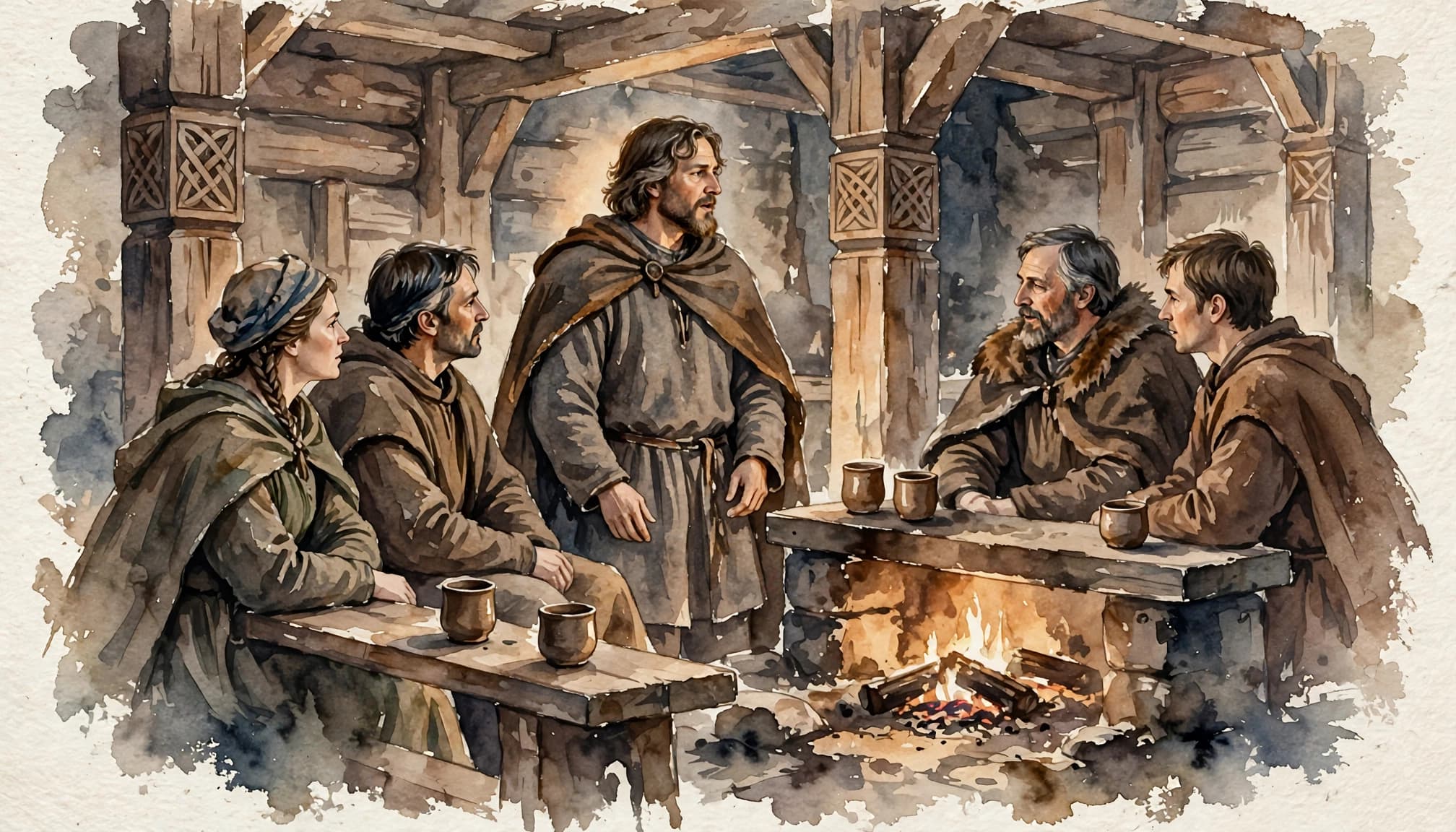
Firelight catches the cups in a crowded Norse longhouse, while food and mead bring people together. It’s an inviting image, but mead halls also belonged to the serious business of hospitality, leadership, and community life.
I find these spaces most interesting when the drinking becomes part of a bigger picture: who gathered, who hosted, and whose stories survived. To understand their daily and ceremonial roles, start with the household behind the feast.
Key Takeaways about mead halls
- A mead hall was a great hall associated with a ruler’s or chieftain’s household, not a tavern devoted to selling drinks.
- Hosting brought people together for food, drink, and conversation, while seating and company could make differences in rank and influence visible.
- Mead was a valued drink, but it wasn’t the only drink at gatherings or a standard feature of every feast.
- Archaeological remains and literary works offer different kinds of evidence about Norse halls, their communities, and their cultural meaning.
What Mead Halls Were and How They Were Built

“Mead hall” is a useful modern label for a great hall associated with a ruler’s or chieftain’s household. It doesn’t mean a tavern devoted to selling drinks. The household setting matters because guests could gather and authority could be exercised within the same domestic world.
Cambridge University Press’s discussion of dwelling in Viking Age Scandinavia places the Scandinavian-style longhouse at the center of domestic life. That’s a better starting point than treating every timber building as a Viking drinking establishment with unusually dramatic decor.
However, a great hall and an ordinary dwelling weren’t interchangeable categories. Elite gathering places belonged to particular households and local settings. Their buildings varied across Scandinavia and through time, so one familiar reconstruction can’t stand for every Norse community.
Elite estates relied on domestic resources such as crops, livestock, and beekeeping. Mead was an expensive luxury made from fermented honey and water, which made honey a valuable commodity. The household compound could bring together high-status nobility, local peasants, and laborers. I prefer to picture a working household that could accommodate important gatherings, rather than a permanent party waiting for someone to refill the cups.
How Mead Halls Worked in Norse Society
Hospitality brought people into a host’s household, where a gathering put leadership on public display. Food and drink gave people a reason to spend time together, and hosting an elite drinking feast displayed household resources to guests.
Where guests sat showed rank and belonging
Rank shaped Norse society, so a gathering didn’t make everyone socially equal. A chieftain might seat trusted warriors nearby, affirming their rank and expectations of fealty.
However, the broad importance of status doesn’t give us a universal seating chart. Leaders and honored guests might drink from silver goblets, while others used horn vessels. I find the larger distinction more useful: inclusion in a gathering and equality within it are different things.
A communal chamber could bring people together while still making differences in authority apparent. Its community had boundaries, and its members didn’t all hold the same influence.
Mead and feasting made gatherings a shared ceremony
For mead lovers, the drink naturally draws attention. Its place in Norse cultural memory gives these gatherings an appeal that a discussion of household organization alone probably wouldn’t manage.
Yet the name for these communal gatherings doesn’t establish what everyone drank at every occasion. Mead belongs within a wider history of hospitality and celebration, alongside everyday ale, rather than one standard feast repeated across Scandinavia.
I enjoy the connection between mead and company, but keeping that distinction clear leaves room for different households and occasions. The drink mattered within the gathering, alongside the people around it.
Why Mead Halls Were Places for News, Deals, and Stories
Gatherings connected people and information
When people met in a prominent household, conversation extended beyond the meal. Visitors brought knowledge of people and events beyond the immediate household, while shared company gave relationships a public setting.
That helps explain the gathering space’s political importance without turning every feast into a formal council meeting. Leadership depended partly on relationships, and a gathering made those relationships visible.
For a guest, the company mattered as much as the host. The social center brought people into contact, although the purpose and character of each gathering could differ.
Poetry gave reputation a longer life
A skilled minstrel or skald could give a leader’s deeds an audience and extend his reputation. The Anglo-Saxon epic Beowulf depicts King Hrothgar and the terror of Grendel. Its verses preserve deeds and give listeners a shared store of memory.
Norse mythology makes the association between mead and eloquence wonderfully explicit. In the story of the Mead of Poetry, Odin obtains a magical drink that grants wisdom and poetic ability.
I love the ambition of a beverage that promises better verse. However, myth and historical practice are different kinds of evidence. The tale connects mead with inspiration; it doesn’t establish a literal ceremony performed in a timber room. Its relevance lies in that cultural association between drink, knowledge, and skilled speech.
What the Hall Reveals About Norse Power and Community
A leader’s timber gathering place brought household life into contact with public authority. Its hospitality had a visible setting, while guests showed the household’s connections beyond its own members.
Archaeology adds something firmer than a memorable literary scene. The study Halls at Borre describes three large buildings identified through ground-penetrating radar at the Norwegian royal burial site. Such discoveries give researchers physical evidence of high-status buildings.
However, physical remains and written stories answer different questions. Archaeology can reveal buildings and their setting. Literature gives access to descriptions, values, and remembered or imagined events, but it isn’t a recording of an evening’s conversation.
Norse communities varied across times and places, and their timber structures reflected that range. Later Scandinavian communal leadership differed from the feudal court systems the Normans introduced after the Norman conquest. A royal coronation feast offered public spectacle, unlike intimate chieftain hospitality. Buildings and stories each add evidence, but neither tells the whole story.
Frequently Asked Questions about mead halls
What was a Norse mead hall?
A mead hall is a modern label for a great hall associated with a ruler’s or chieftain’s household. It was part of a domestic setting where guests could gather and authority could be exercised.
What happened in a mead hall?
Guests shared food and drink, met other people, and heard news and stories. Hosting also displayed the household’s resources and relationships.
Did every Norse gathering serve mead?
No. Mead was an expensive luxury made from fermented honey and water, and gatherings could include everyday ale. The name “mead hall” doesn’t establish what everyone drank at every occasion.
What can archaeology tell us about Norse halls?
Archaeology can provide physical evidence about buildings and their settings. The study of Halls at Borre describes three large buildings identified through ground-penetrating radar at a Norwegian royal burial site.
Do stories about mead halls describe historical events exactly?
Literary works and myths preserve descriptions, values, and remembered or imagined events, but they don’t record every gathering as it happened. The Mead of Poetry story connects mead with wisdom and poetic ability, but it doesn’t prove that a particular ceremony took place in a timber hall.
A Gathering Place Beyond the Mead
The crowded communal room becomes more interesting when you notice the household around the feast. Hospitality created company, while rank and storytelling shaped what that company meant.
For me, the heart of the gathering is its people. Mead adds warmth to its cultural memory, but the people give the scene its importance. Their relationships explain why these spaces mattered long after the cups were empty.